Library Records: A Practical Guide to a Playful Display Font
When selecting typography for educational materials, children's activity books, or school projects, the choice of typeface often dictates the tone and accessibility of the content. Library Records has emerged as a distinctive option in this space, offering a unique blend of humility and playfulness that resonates with young audiences. Unlike many modern sans-serif fonts that prioritize geometric perfection or minimalism, Library Records embraces a more organic, hand-crafted aesthetic. It is designed to feel authentic rather than manufactured, making it an ideal candidate for contexts where warmth and approachability are paramount.
This evaluation explores the specific characteristics of Library Records, examining how its design philosophy aligns with the needs of educators, parents, and designers working on youth-oriented projects. By understanding the nuances of this display font, users can determine if it fits their specific requirements better than other available options.
Understanding the Distinctive Character of Library Records
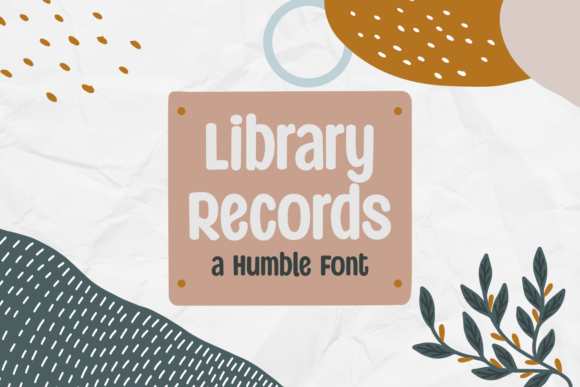
At its core, Library Records is defined by its ability to convey a sense of nostalgia and genuine creativity. The font mimics the irregularities found in hand-lettering or early printing methods, avoiding the rigid uniformity that characterizes many standard digital typefaces. This "cool and humble" quality allows the text to sit comfortably alongside illustrations without dominating them or appearing overly polished.
The distinctiveness of Library Records lies in its stroke variations and letter spacing. These subtle imperfections create a rhythm that feels inviting to children, who are often drawn to shapes that appear less formal. When used in headers or titles, the font acts as a visual cue that the content is fun and accessible. For adults reading the material, the font strikes a balance between professional legibility and creative flair, ensuring that the project does not look like a cheap template but rather a thoughtful, custom creation.
In terms of usability, Library Records functions best as a display font. This means it is optimized for headlines, posters, and large-format text rather than long-form body copy. The playful nature of the letters can become difficult to read at small sizes or when set in dense paragraphs. However, within its intended scope, it excels at capturing attention and setting a positive emotional tone for the reader.
Evaluating Fit: When Library Records is the Right Choice
Selecting the right typography involves matching the visual style to the intended outcome. Library Records is particularly well-suited for scenarios where engagement and relatability are the primary goals. Its design philosophy aligns perfectly with environments that encourage exploration and learning through play.
- School Projects: Teachers and students often need fonts that make assignments look exciting. Library Records adds a personal touch to presentations, worksheets, and classroom displays without requiring advanced graphic design skills.
- Children's Activity Books: In coloring books, puzzle sheets, and workbooks, the font serves as a guide that feels friendly. The authenticity of the letterforms helps bridge the gap between the adult creator and the child user.
- Community Events: For flyers regarding library programs, local workshops, or family days, Library Records communicates inclusivity. It suggests that the event is open to everyone and focuses on enjoyment rather than strict academic rigor.
The decision to use Library Records often comes down to the desired atmosphere. If a project aims to feel structured, corporate, or highly technical, this font would be inappropriate. However, if the goal is to foster a sense of curiosity and joy, the font's inherent qualities provide a strong foundation for the design.
Comparative Analysis: Library Records vs. Standard Alternatives
To make an informed decision, it is helpful to compare Library Records against common alternatives found in the typographic landscape. Most designers have access to a wide range of fonts, from classic serif families to modern grotesque sans-serifs. Understanding where Library Records sits in relation to these categories clarifies its value proposition.
Library Records vs. Geometric Sans-Serif Fonts
Geometric sans-serif fonts (such as those based on perfect circles and straight lines) are popular for their clean, modern look. They are excellent for readability and conveying efficiency. However, they can sometimes feel cold or sterile when applied to children's content. Library Records offers a warmer alternative. While geometric fonts rely on mathematical precision, Library Records relies on human expression. This makes Library Records superior for projects that need to evoke emotion or storytelling, whereas geometric fonts remain the better choice for data-heavy interfaces or minimalist branding.
Library Records vs. Handwritten Scripts
Another common category includes handwritten scripts that attempt to mimic cursive or casual writing. While these fonts also offer a personal touch, they often suffer from legibility issues, especially when viewed by children who are still learning to read. Library Records maintains a higher level of clarity while retaining a hand-drawn feel. It avoids the excessive flourishes and connected strokes that can confuse young readers. Therefore, for educational materials where word recognition is key, Library Records provides a safer and more effective option than traditional script fonts.
Library Records vs. Bold, Cartoonish Typefaces
Some display fonts lean heavily into a "cartoon" style, using exaggerated weights and rounded edges. While these are undeniably playful, they can sometimes appear juvenile or dated depending on the execution. Library Records takes a more mature approach to playfulness. It is "cool" because it doesn't try too hard; it feels authentic rather than forced. This distinction is crucial for older elementary students or teenagers who might reject fonts that look too babyish. Library Records scales well across age groups, maintaining its appeal from toddlers to pre-teens.
Navigating Tradeoffs and Limitations
No single font is a universal solution, and Library Records is no exception. Acknowledging its limitations is essential for responsible design. The primary tradeoff lies in its versatility. Because it is a display font with a strong personality, it cannot be used effectively for all text elements in a project.
Designers must pair Library Records with a neutral, highly readable body font. Attempting to use it for long passages of text will result in eye strain and reduced comprehension. The irregular shapes and varying stroke widths, which give the font its charm, become obstacles to rapid reading when the volume of text increases. Consequently, a successful design using Library Records requires a complementary typeface that handles the bulk of the information delivery.
Additionally, the availability of different weights and styles may be limited compared to major commercial type families. If a project requires extensive variation in hierarchy—such as multiple levels of headings, captions, and emphasis—the designer must ensure that Library Records offers enough stylistic range to support the layout. In some cases, relying solely on size changes might be necessary, which can limit the visual impact of the hierarchy.
Strategic Decision Factors for Users
When evaluating whether to incorporate Library Records into a workflow, several practical factors should guide the decision-making process. First, consider the medium. Digital screens and print materials handle fonts differently. Library Records generally performs well on high-resolution prints, where the texture of the letters can be appreciated. On low-resolution screens or mobile devices, the fine details of the font might get lost or pixelated, potentially diminishing its effect.
Second, assess the target audience's familiarity with the content. If the project is for a specialized group, such as advanced learners or professionals, the playful nature of Library Records might undermine the perceived authority of the material. Conversely, for general audiences or community outreach, the font builds trust through its transparency and lack of pretension.
Finally, consider the longevity of the project. Trends in typography change rapidly. A font that feels trendy today might feel outdated in a few years. Library Records draws inspiration from timeless, classic forms, which gives it a degree of durability. It avoids the extreme stylizations that often date quickly, making it a sound investment for resources that will be reused over time.
Conclusion on Selection
The choice of typography is a critical component of communication, influencing how messages are received and interpreted. Library Records stands out as a specialized tool designed to bring warmth, authenticity, and playfulness to visual content. It is not merely a decorative element but a strategic choice for engaging children and fostering a love for learning.
While it may not replace standard fonts for every task, its unique position in the market makes it an invaluable asset for specific use cases. By understanding its strengths in creating an inviting atmosphere and recognizing its limitations regarding body text and formality, users can leverage Library Records to enhance their projects effectively. Whether for a school bulletin board, a summer camp flyer, or a creative workbook, this font offers a humble yet powerful way to connect with young minds.
For those seeking a font that balances structure with soul, Library Records represents a compelling option. It invites users to step away from the rigid constraints of standard digital typography and embrace a more human-centric approach to design. As you evaluate your next project, consider whether the authenticity and playfulness of Library Records align with your vision. If so, it could be the perfect finishing touch that transforms a standard document into an engaging experience.